
Blogs

What Is Latex Paint? Uses, Benefits & Common Myths
Latex paint has become the overwhelmingly dominant choice for professional and DIY painting projects across the United States. Its evolution from a basic coating to a highly technical, durable finish has revolutionized the painting industry. Understanding what latex paint truly is, its benefits, and its proper application is essential for achieving a masterful finish.
Quick Answer: What Latex Paint Really Is
Water-Based Paint Explained in Simple Terms
At its core, latex paint is a water-based coating. This means that water is the primary solvent (or carrier) that keeps the binder and pigment particles suspended.
When applied to a surface, the water evaporates first, causing the microscopic binder particles (usually acrylic or vinyl resins) to coalesce and form a continuous, durable film. This process is called coalescence. The pigment particles, which provide color and opacity, are embedded within this binder film.
The binder is the most critical ingredient, determining the paint’s performance:
Vinyl Acrylic (PVA): Often used in budget-friendly interior paints. Offers decent coverage and durability.
100% Acrylic: The premium choice. Acrylic resins create a more flexible, strong, and highly durable film that resists chalking and fading, making it ideal for both interior and exterior applications.
Why “Latex” Paint Doesn’t Actually Contain Latex Rubber
The term "latex" is historical and widely misleading today. The very first water-based paints, developed in the 1940s, used a rubber latex (specifically, Styrene-Butadiene rubber) as the binder.
Modern latex paints do not contain natural rubber latex. Instead, they primarily use synthetic acrylic or vinyl resins. However, the name "latex paint" stuck as a general term for all water-based emulsion paints, distinguishing them from traditional oil-based (alkyd) paints. If you have an allergy to natural rubber latex, modern acrylic or vinyl latex paints are safe to use.
Main Benefits of Latex Paint
Latex paint offers several significant advantages that make it the preferred choice for most painting projects.
Fast Drying Time
The most immediate benefit is the fast drying time. Since water evaporates much faster than the mineral spirits or solvents found in oil-based paints, latex paint can be dry to the touch in as little as 30 minutes to 1 hour.
This quick turnaround allows painters to apply a second coat (recoat time) much sooner—typically within 2 to 4 hours. This dramatically speeds up project completion, especially in interior settings where quick occupancy is desired.
Low Odor and Easy Cleanup
Latex paint is often referred to as "low-VOC" (Volatile Organic Compound) or "zero-VOC." While all paint contains some level of VOCs, modern latex formulations are drastically lower than traditional oil-based paints.
Low Odor: The reduced solvent content means less potent and unpleasant fumes during application, improving indoor air quality and comfort.
Easy Cleanup: Tools, brushes, and minor spills can be easily cleaned with warm water and soap, eliminating the need for harsh chemicals like paint thinner or mineral spirits.
Flexible Finish That Resists Cracking
The synthetic acrylic binders in high-quality latex paint create a finish that is inherently flexible. This is crucial for materials like wood, siding, and drywall that naturally expand and contract with temperature and humidity changes.
Exterior: The flexibility prevents the paint film from cracking and peeling when the sun heats the exterior surface.
Interior: It helps the paint absorb minor impacts and prevents damage at seams and joints in drywall.
Breathability: Latex films are microporous, meaning they allow moisture vapor to escape from the substrate, reducing the risk of blistering and mildew when moisture is trapped behind the film.
Where Latex Paint Works Best
Latex paint is highly versatile, but the specific formulation (vinyl vs. 100% acrylic, and the sheen) determines its ideal application.
Interior Walls and Ceilings
This is the classic application for latex paint. Its fast drying time, low odor, and ease of application make it perfect for large surface areas like living rooms, bedrooms, and hallways. Lower-sheen finishes (flat, matte, eggshell) are typically used for walls and ceilings to help hide minor surface imperfections.
Trim, Doors, and Cabinets (With the Right Formula)
Historically, oil-based paint was the standard for high-contact surfaces due to its hard finish. However, modern 100% acrylic latex enamels have closed the gap significantly.
Urethane-Modified Acrylics: These premium latex formulas are designed to level out beautifully (minimizing brush or roller marks) and cure to a much harder, more durable finish that resists blocking (sticking) and chipping, making them ideal for trim, doors, and kitchen cabinets.
Exterior Applications (Modern Latex Formulations)
Modern exterior latex paint, almost universally 100% acrylic, is superior to oil-based paint for most exterior siding (wood, fiber cement, aluminum). Its key advantages outside are:
UV Resistance: Acrylic binders resist damage from the sun's ultraviolet rays, meaning the color holds its vibrancy longer (resists chalking and fading).
Adhesion: It adheres well to various substrates and can withstand extreme temperature fluctuations without cracking.
Flexibility: It moves with the siding, which prevents the moisture penetration that causes peeling.
Latex Paint vs Oil-Based Paint
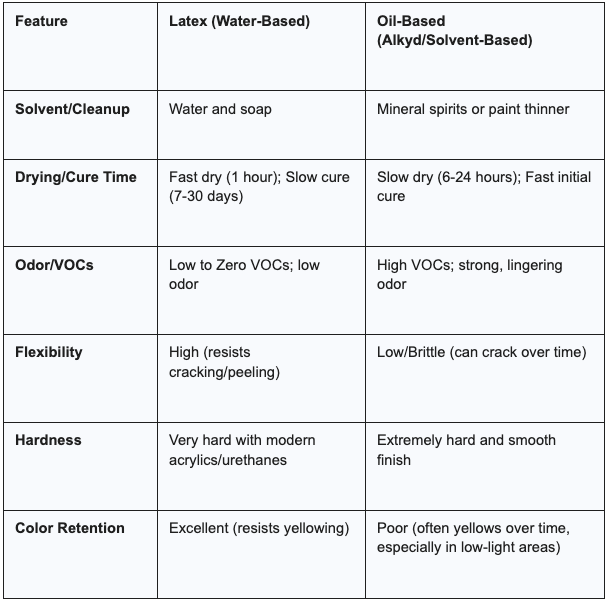
Durability and Flexibility Comparison
While traditional oil-based paint achieves a harder initial surface, it becomes brittle over time, making it susceptible to cracking, especially on substrates that move.
Premium 100% acrylic latex paint achieves a high degree of hardness while maintaining elasticity. This combination—hard surface resistance combined with flexibility—often makes modern latex paint a better long-term choice for durability on both interior and exterior surfaces.
VOC Levels and Indoor Air Quality
This is where latex paint is the clear winner for interior projects. The high solvent content in oil-based paints releases high levels of VOCs, which can be harmful to indoor air quality and require extensive ventilation. Latex paint meets stringent environmental regulations, making it the healthier and more environmentally responsible choice for almost all interior residential work.
Ease of Maintenance and Repainting
Latex paint is much easier to maintain. Scuffs and marks on higher sheens can often be wiped clean with a damp cloth. When it's time to repaint, latex can typically be applied directly over old latex or even properly prepared oil-based paint. However, if you are painting oil-based over latex, you must apply a high-quality bonding primer first.
FAQs
Is latex paint durable enough for high-traffic areas?
Absolutely. For high-traffic areas like mudrooms, hallways, and children's rooms, painters recommend choosing a high-quality, 100% acrylic formula in a higher sheen (satin, semi-gloss, or gloss). The higher the sheen, the tighter the paint film, which results in a finish that is more washable, easier to scrub, and highly resistant to stains and wear.
Can latex paint be used in bathrooms and kitchens?
Yes, and it is highly recommended. In high-humidity environments like bathrooms and kitchens, latex paint is preferred because of its breathability. It handles moisture vapor better than oil-based paint, which is prone to blistering when moisture is trapped. Be sure to use a paint specifically rated for high-moisture areas, which contains mildew-inhibiting additives and has a washable sheen (satin or semi-gloss).
Is latex paint better than oil-based?
For the vast majority of modern residential and commercial painting projects, yes, latex paint is considered superior.
While oil-based paint still has niche uses (like painting rusty metal or sealing deeply stained wood), latex paint offers better flexibility, better color retention (won't yellow), easier cleanup, faster recoat times, and is healthier to use due to low VOCs. Advancements in 100% acrylic technology mean that the durability and finish quality now meet or exceed that of traditional oil-based coatings.
Achieve the ultimate factory-smooth finish with Masterpiece Painter.
Choosing the right paint is only the first step; achieving a flawless finish requires expert preparation and precision technique. Let the skilled artisans at Masterpiece Painter handle your next project, ensuring durable, high-quality results using premium, low-VOC latex coatings.
Contact Masterpiece Painter today for a consultation and experience the art of perfect painting.

About Masterpiece Painter
For over 17 years Masterpiece Painter, has been serving communities all around New England. Let us help you make your wishes come true by turning your property into a Masterpiece
Get a Quote
Contact Us




© copyright 2023 All Rights Reserved.